
Every morning, like clockwork, we get up and walk down the beach front path, past Disney’s Aulani resort to the Four Seasons where the path appears to end with a circular spot in the path, but it doesn’t. The path continues until it narrows amongst the lush landscaping in front of the Four Seasons. At the end of the narrow path, you transition through the green hedges to the rocky beachfront for your final approach to Secret Beach to see if any monks are resting on the sand.
This might sound very spiritual and remote, but in actuality, it’s become a touristy thing to do in Ko Olina, Hawaii. The monks are endangered Hawaiian Monk Seals, and the “Secret Beach” is not as much of a secret anymore. What was once a secluded lagoon tucked around the corner from the JW Marriott has become a hotbed for monk watchers and photographers alike. Oh, and the JW Marriott is now the Four Seasons Resort.


We always seem to hold our breath as we near the end of the path and peek around the corner to see if any sightseers are crowding around. That’s a sure sign that there’s a monk resting on the sand. When the Secret Beach was still mostly undiscovered, we would often find a monk on the beach without any posted signs or rope barriers yet. This was very exciting!
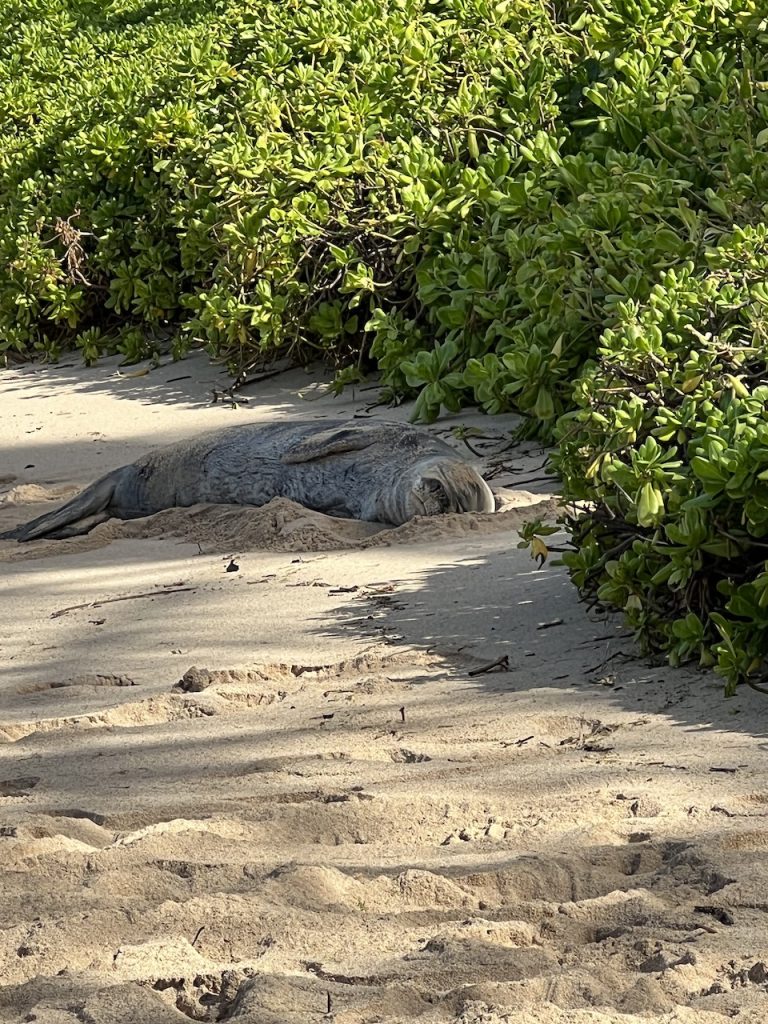
We would then call in the sighting to the Hawaii Marine Animal Response (HMAR) or National Oceanic and Atmospheric Administration (NOAA) and let them know we had spotted a monk on shore. They usually asked us to wait there until a volunteer could show up with signs encouraging spectators to keep a safe distance away.
The recommended viewing distance is 50 feet (15 meters) away. We always took this job very seriously! There was no way we were going to let anyone get close enough to disturb its sleep or make it feel threatened. We often joked that we should sign up to be volunteers since we spent so much time on that beach watching the monks or waiting for them to arrive.
FACT: Hawaiian monk seals are heavily protected under federal and state laws, including the Endangered Species Act (ESA) and Marine Mammal Protection Act (MMPA), making it illegal to take, harass, touch, or feed them. Violations can result in felony charges, with penalties including up to five years in prison and $50,000+ in fines.


That is how we met Barbara. Barbara and her husband had been NOAA volunteers for 17 years and now monitor the west side of Oahu beaches, unofficially. She is well known and respected among the monk seal community. You can spot her right away with her sun hat, walking stick, huge camera, and “Monk Mom” t-shirt. Yes, her husband has a “Monk Dad” shirt too! After seeing her for several years in a row, we eventually started saying hello each time we saw her. I’m not sure she remembers us from year to year, but we always look forward to seeing if she’s still around.


What I love while traveling
When traveling, I love it when I come across a good human interest story. That’s probably why I was so drawn to Barbara. She is one of a kind. She practically blends into rocks because she has spent so much time with the monks. The best way to find her is by following her walking stick holes in the sand.
The volunteers, often interns in marine biology, do a great job of educating people coming to see the monks and keeping the monks safe at the same time. The volunteers often stay with the monks for many hours. Sometimes they are relieved by another volunteer, but other times, they have to stay there the whole day without relief. It indicates to me that marine biology is full of people that love what they do!
One day, a tourist had walked across the beach to get to the other side of the lagoon. While he was looking around the rocks, a monk had swam up and nested itself on the sand. With the high tide, the only way for this man to get back to the walking path side of the lagoon was to walk between the monk and the water, which was only about 10 feet wide at the time.
He spent at least 30 minutes trying to figure out a way to get back to our side of the beach without disturbing the now watchful monk. Several people had congregated near us at this point calling out suggested ways to get past the monk. Some said, “Run fast!” Others said, “Don’t run or it will chase you.” The man eventually walked mostly into the water and stumbled his way across the lagoon with a nervous crowd silently watching his every step.
I felt like this was the worst path around the monk. He looked like an injured animal fighting his way up the beach. If I were a monk seal, I definitely would have chased him off my beach. If a volunteer had been there that day, I’m sure he or she would have had a better suggestion for the trapped tourist.
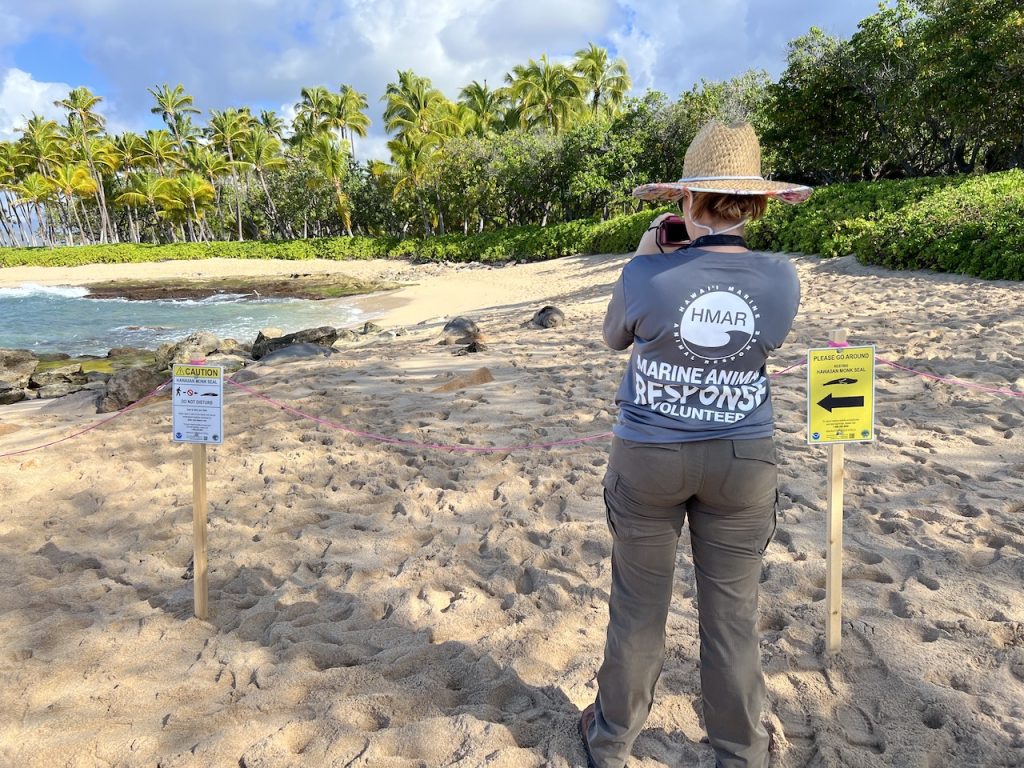
The volunteers, often interns in marine biology, do a great job of educating people coming to see the monks and keeping the monks safe at the same time. The volunteers often stay with the monks for many hours. Sometimes they are relieved by another volunteer, but other times, they have to stay there the whole day without relief. It indicates to me that marine biology is full of people that love what they do!
Four Seasons (formerly the JW Marriot)
After a 20-month and approximately $500 million facelift, the JW Marriott is now the Four Seasons. The pool area closest to the beach appears beautiful to those walking by toward the Secret Beach. Though Secret Beach is not as much of a secret as it once was, I will hazard a guess that many of the people spending $1,000+ per night do not realize that one of the most amazing beaches in the world sits a stone’s throw away from their poolside chaise and lemon infused water spritzes! The narrow path is now more crowded, but the monk seals still seem to love it. I understand why so many people are drawn to the beach, but on a personal level, I wish we could go back to the days of quietly stumbling across a resting monk and it actually being a secret.
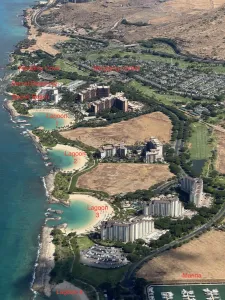
Location: Secret Beach is in the Ko Olina resort community on the leeward (West) side of Oahu. The beach is tucked between Paradise Cove and The Four Seasons Resort. The easiest way to access the beach is from the walking path that runs in front of Disney’s Aulani and The Four Seasons Resorts.
Parking: Parking is very limited. There are 6 public lots for beach access. Go early, as they fill up quickly, and there are always cars waiting in line. For Secret Beach, the ideal place to park is in lots 1A and 1B, and walk the rest of the way on the path. When the path dead ends, walk over the rock and follow the people.
Ko Olina’s shopping center has public parking for retail and restaurant customers. Parking is available daily from 5 am – 11 pm and is currently around $2.50 per hour, with a three hour maximum but they do have dynamic pricing so it could be more or less. Also, THEY DO GIVE TICKETS THERE IF YOU DO NOT PAY!
Things to bring:
- Good shoes to walk over wet rocks
- your camera
- water
- You can bring sand toys, but if the monk seals are on the beach, there isn’t anywhere else to play.
What’s nearby: The community of Ko Olina is not hopping with activity. There are a few key places where everyone goes. Monkeypod Restaurant is famous for their Mai Tai with foam topper and huge slices of pie.


The newest place we found is 808 Craft House. They specialize in Farm to Table and Grain to Glass, with great, open air seating which you can read more about here: . They even have a golf cart that will drive you between the restaurant and your “home away from home,” a.k.a. your hotel room.
Cost: Free!
Bathrooms: None, but you can walk along the path to one of the lagoons and use the public restrooms which have outdoor showers and drinking fountains.
Random details: There are no lifeguards at any of the lagoons/beaches in Ko Olina. Personal shade umbrellas are not allowed.