I got the call from my local American Red Cross deployment team the day before I was to fly my daughter from Las Vegas to New York to start her sophomore year at NYU. I was told there were several hoops to jump through before I could officially be deployed, so I hopped on the plane to New York the next morning.
Before I go on, let me set the stage of my experience deploying with the Red Cross. I have been deployed 3 times in the previous 18 months to Illinois, Washington, and Florida. I was in St. Louis and Tallahassee/Kissimmee/Orlando to help with respective flooding efforts and eastern Washington to help with recovery after the wildfires. All three deployments provided different challenges, and within each deployment, things were constantly changing. Often, teams were moved from town to town or jobs changed based on the needs of the clients. In Florida, my team was constantly on the move chasing Hurricane Ian to see where it would hit land.
You might be deployed to work in the shelters but be transitioned to work as a Shelter Resident Transition worker if that’s where the need is the highest, assuming you’re trained for that position. My positions at the Red Cross have ranged from Disaster Action Team Supervisor, Disaster Services Workforce, Recovery Intake Worker, Caseworker, Blood Donor Ambassador, Mass Care: shelter and feeding. I’m currently in training to assist with the Mass Casualties team.
While on our layover in Denver on the way to New York, I received a call from the Red Cross Health Services to do my mental health check for deployment. Luckily, I had enough time to get my clearance before taking off on the final leg of our journey to New York. To say this was a hectic way to start my deployment would be an understatement! Over the next two days, I helped my daughter move into her new dorm, flew back across the country, and stopped overnight in Nashville due to a plane malfunction. I landed in Las Vegas about 8:00 AM just in time to pack and catch the 12:00 PM flight to Hawaii.
A little backstory…
My family has vacationed in Maui many times, primarily in the Kaanapali resort area, which is just four miles north of the historic Lahaina Town. Back then, you would take the Honoapi’ilani Highway (Hawaii Route 30) all the way to Kaanapali, driving directly through Lahaina. As of 2013, the Lahaina Bypass lets you avoid the local traffic, and Kaanapali is much easier to get to. The Honoapi’ilani Highway, including the bypass, is the only real road there, unless you count Kahekili Highway which is a 20 mile, one lane road with extremely narrow passes, sheer cliff drop offs, crumbling rock walls, and snaking turns. Unfortunately, Google Maps was showing the Kahekili Highway as an option to get to Kaanapali, and a few volunteers ended up on it. That is one drive they will never forget!
Lahaina has over a thousand years of rich history and was once the capital of the Kingdom of Hawaii. Before the fire, Lahaina saw 80% of all Maui tourism per year, accounting for about two million people. Lahaina’s iconic Front Street was recognized by the American Planning Association as one of the “Top Ten Greatest Streets.” This mile-long stretch is filled with art galleries, restaurants, shops, Old Fort Ruins, and even the old Courthouse, which is now a Heritage Museum.
We would often go into Lahaina to shop at the outlet mall, see the Warren & Annabelle’s Magic Show, eat at Cheeseburger in Paradise, do wishful shopping at the Wyland Gallery, get henna tattoos, eat ice cream under the 150 year old banyan tree, and take the Pacific Whale Foundation whale watching trip. The last time we were in Lahaina was a few years ago on the 4th of July to watch the fireworks!
While Lahaina has charm, culture, and history, Kaanapali is magnificent planned-resort area. With six oceanfront resorts, luxury villas, condominiums, and a championship golf course, Kaanapali is the complete opposite of Lahaina. Neither is better or worse; they are just different. The two areas offer something for everyone. We love staying in Kaanapali and spending time in Lahaina. I’m sure people may be critical of my basic descriptions of the two areas, but that’s generally how I see it. Both are great!
Deployment Arrival Day
I was greeted at Kahului Airport baggage claim by local volunteers who were in charge of helping people get to the Red Cross headquarters. Headquarters were housed at Queen Kaahumanu Center, only about five minutes from the airport. It had been about a month since the fires, and by then, the rental car agencies had already made plans for the new normal of having fewer tourists on the island. Thousands of rental cars were hibernating nose to tail, obviously not going anywhere anytime soon.
Upon opening the door to headquarters, I was immediately thrown into a different world. The airport and streets were relatively empty, yet this space was overflowing with tables, computers, charts, maps, phones, and people. There were red vests everywhere! Volunteers to check you in, assign lodging, arrange transportation, confirm your clearance, issue you technology, instruct you on your job details, and so much more. There was no time for general chit chat. It was time to get to work!
The South Maui Community Gym was where I was assigned to sleep and eat for the next three weeks.
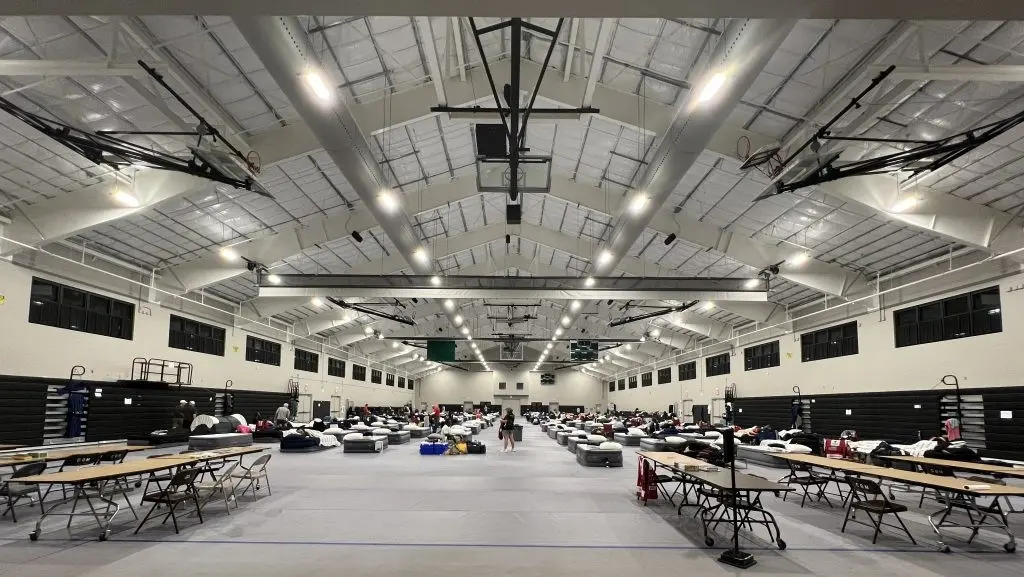
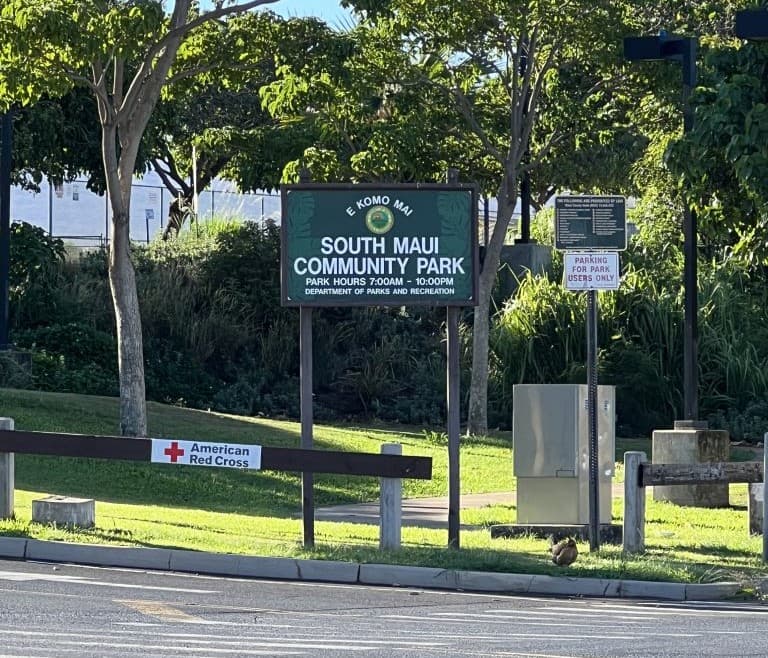
It is in the town of Kihei about 25 minutes from headquarters and 45 minutes from Lahaina. The gym housed about 150 Red Cross volunteers on any given night. We all slept on air mattresses in one big room. There were two large bathrooms for the women and two for the men, with only four showers in the entire place! While that was somewhat inconvenient, it somehow managed to work, and I never had to wait more than a few minutes for a shower. Maybe we were all too tired to even try to keep ourselves clean. The worst part about the bathrooms was the hand dryers. They would go off automatically whenever something near them moved. Unfortunately, we put our things on the tables directly under the blowers, as there were no other counters, so anytime someone moved things on the tables, they would go off, at all hours of the night! I laughed to myself every night when this happened since it was such a silly thing to be bothered by given what consumed our days. If the hand blowers were the worst part of the lodging, then that’s pretty good, I think. Some seasoned volunteers had important things that I forgot, but will never forget again including Ziplock bags, blue painter’s tape, and SHOWER SHOES! I definitely updated my packing list after this deployment. One lady even had a tent that encompassed her whole air mattress!
Portable charging devices were a must, and I was very popular with my 10 foot extension cord and power strip. Since beds were spread out around the room, only a few people had access to outlets on the wall. That was the first thing I looked for when I selected my space. Yay me! There were a few folding chairs available throughout the gym, so I claimed one and kept it by my bed. I had a nightly ritual of playing Sudoku and chatting with friends while sitting in my chair. Then, at precisely 9:55 PM, I would move onto the bed before lights out at 10:00 PM. I learned the hard way on my first night that there is no warning about when the lights go out. You just have to be ready for the pitch black to come.
As sure as the lights going out at 10:00 PM, the alarms would start going off at 4:00 AM. The gym lights wouldn’t turn on until 6:00 AM, but volunteers who had early shifts or needed lots of time to get ready would set individual alarms for themselves. That was fine, except that we were all sleeping in a room together, and when one person woke up, we all did.
Sleep was precious. I craved sleep. During the night, there was always a cacophony of sounds. Sleep apnea machines (which stole most of the outlets), people coughing (which made everyone worry the person was sick), loud snorers, people thinking they are whispering while talking on the phone, and the outright rude. An older lady was listening to music on her cell phone speaker as I walked to the bathroom in the dark one night. I said, while giving her a little smile, “Oh, I was wondering where the music was coming from.” She looked at me and said, “Oh, was I bothering you?” I wanted to say yes, but instead said, “Oh no, I was just wondering.” She replied saying, “Oh, ok. If I was bothering you, I’d turn it up!” I don’t think she is the best suited to work with the Red Cross.
Luckily, I found the most amazing set of ear plugs, the little, orange, foam things, and they were free! They worked perfectly! After using them, I started sleeping until the lights turned on. I even slept through my neighbor falling off his bed multiple times a night.
Breakfast usually consisted of heat-and-serve egg sandwiches, cereal cups, protein bars, muffins, and Pop-Tarts. The strawberry Pop-Tarts were always the first to go. I might have had something to do with that!
Us Red Cross volunteers were lodged all over the island, but we were primarily in Kihei and Kaanapali. Some staff shelters had two people to a room with small kitchens (timeshare units), while other shelters had four or five to a space with people sleeping on couch beds (apartments). If there was a place for volunteers to sleep, then it was occupied. Many locals and Airbnb owners offered their units to volunteer organizations in the early part of the recovery process. I heard stories that the first wave of volunteers were sleeping in RVs and at camp sites. Basically, people slept anywhere they could be horizontal for a few hours. How well you ate depended on where you stayed. We did not have access to a refrigerator at the gym, so we couldn’t keep perishable foods with us. Likewise, depending on where you were working, you either were fed meals or you had to bring your own lunch. I usually had to bring my own food, which made it difficult since I didn’t have access to a refrigerator at my shelter or work location. Needless to say, I didn’t have a lot of food options. I should add here that when we agree to deploy, we know we are going into a disaster area and are not expecting easy shelter, frequent meals, and/or the normal comforts of home. We sign up for this knowing what we are getting into. I am solely describing what the situation was like, certainly not complaining.
In Tallahassee, I recall sleeping on the floor of a classroom for several nights, which felt like 6 months, with the lights on 24 hours a day since they were controlled by the district, and we were unable to turn them off. My favorite sleeping spot was in Kissimmee, Florida where we each got our own private “suite” in the Silver Spurs Arena Heritage Club. There was just enough room for a cot because each tiny space had a table and chairs, a bar sink, and a mini fridge.
Some staff and volunteers were housed at the fancy resorts in Kaanapali, which was a touchy subject amongst Red Crossers. Many were jealous because some people were “living in paradise” while the rest of us were not. Also, Red Cross higher-ups were very nervous about social media posts being shared giving the appearance that Red Cross workers were staying in such luxury. I cringed when I saw some of the “vacation type” posts because I knew those lodging situations were rare and didn’t represent an accurate picture of the typical living conditions of volunteers.
I was deployed as a Red Cross Intake Worker. That basically means that I was the first person to meet with clients and determine how the Red Cross could be of assistance. Here’s a point to clarify. Depending on who you were trained by, you were told to refer to those affected by the fire as either clients, victims, or survivors. Clients would be the term typically used throughout Red Cross in my area, so that is what I will use in this blog.
There are several ways that the Red Cross helps people, financial assistance is just one example. According to the website of the American Red Cross, you do not need to be an American citizen to receive assistance from The American Red Cross. The Red Cross strives to alleviate suffering for all, with humanity and neutrality at its core. The American Red Cross provides financial assistance to those who qualify, as a gift from the American people. It is not a loan to be repaid. To be eligible for financial assistance, households must have met three requirements:
- Prior to the disaster, the residence must be located in the geographic area which was confirmed to be impacted by the disaster. The residence must be destroyed or significantly damaged to the point where it requires extensive repairs or the repairs are not possible due to the extent of the damage.
- The impacted must be able to show proof of their identity and proof of their residence.
- The impacted must apply by the deadline.
If people qualified for financial assistance, then I was able to open a case for them, provide immediate financial aid, assign them shelter (if needed), assign them to a Shelter Resident Transition Worker (if applicable), and overwhelm them with additional resources to consider. People either love intake workers or hate us. All people come to us hoping for help, and it is heartbreaking to try to explain to some that we know they are impacted and hurting, but that they aren’t impacted ENOUGH. That was my job in a nutshell.
There are a few complications with my job that were daily occurrences. One obvious challenge involved the fact that most of the people fled quickly and didn’t have any identification proving who they were or where they lived. They showed up with just the clothes on their backs and, sometimes, their phones. By the time I was deployed to Maui, most of the people had temporary IDs from DMV and a copy of their lease or house deed electronically. Unfortunately, some people had not acquired those things, and while we could provide shelter for them, we could not issue funds until we had actual proof of identification and address.
Another major hurdle was the way many locals resided in Lahaina. Maui is a very expensive place to live, and it was common for 8+ people to share a house and pay rent in cash. There was often no way to prove who paid what to whom. Frequently, people did not have utilities in their name, rental insurance, or signed contracts. Likewise, several generations of families often shared the same house but could only prove that one or two people lived there according to their paperwork.
One of my clients actually lived in a fixed up chicken coop in her neighbor’s backyard. She had been living there for years and paying rent in cash. Her “address” wasn’t verifiable in the system. Many of my co-workers did not think a chicken coop should qualify as a client’s address, but, in my opinion, if it’s where she lived, and that dwelling burned down in the fire, then she was without shelter just like everyone else.
Lahaina has a significant homeless population. Prior to the fire, Lahaina was reported to have the second most homeless people on the island, after central Maui. However, many homeless people in Lahaina consider themselves “houseless” not “homeless.” It is a way of life.
When the fire raced through Lahaina, homeless shelters and camps were destroyed along with everything else. Homeless people, locals, and tourists ran from the fire side by side. They, too, lost everything. The homeless did not have an address prior to the fire, but they had street corners, bridges, store fronts, and cars that were no longer accessible to them. Volunteers worked very creatively to find ways to help this population of Lahaina residents. The staff from Pastor John’s Homeless Shelter was amazingly helpful at identifying these individuals, as many did not have ID.
Another daily problem for intake workers was that it sometimes took a long time for damage classifications to show up in the Red Cross computer system due to the huge number of homes affected. It was clear in some areas of Lahaina that everything within certain boundaries was destroyed. In other parts of town, the fire skipped over some neighborhoods, sometimes skipping just one or two houses on a given street. Each case we opened needed a damage classification for the address, ranging from affected to destroyed. A damage assessment team, often with the help of a drone, needed to look at every single address. Financial assistance was different for homes that could be returned to in the near future versus homes that were completely gone. People would show us videos and pictures of their homes, or the cement pad it once stood on, and it was so frustrating to tell them they needed to wait for our system to catch up.
Another disconcerting part of being an intake worker was the amount of apparent fraud we saw every day. As the first volunteers to encounter clients, it often fell to us to determine the truthfulness of the story being presented. As a volunteer, I genuinely want to help people, and I assume they genuinely need the help. Given the mass destruction that occurred in Lahaina, we dealt with thousands of people, and statistically, not all of them were well-intentioned. One of my favorite fraud stories was about Ikuwa. Historically, tourists are required to wear brightly colored wristbands to show they are registered hotel guests. Ikuwa was caught several times wearing multiple wristbands from various Kaanapali resorts that had been issued to Red Cross clients. Ikuwa was selling the wristbands to islanders who were not affected by the fire but who wanted to stay with friends at the resorts. She would not say how she acquired the wristbands. All I know is that the Red Cross did not have access to the wristbands. They were distributed to clients when they were given their room keys. I’ll leave it up to you to guess how she got them.
Lastly, my own personal frustration was that I was unable to communicate well with some clients due to a language barrier. Spanish and Tagalog were two common languages that I struggled with every day. It was mostly the older generations that did not speak English, and I really wish I could have reassured them that things would be okay in their native language. As some of you know, I have been wanting to learn Spanish and have put it off, with only meager attempts here and there. I am nowhere near fluent. I am extra motivated now though! That will be another post. I really wished that we had a translator available and/or other volunteers who spoke languages other than just English. We really need to be better people! This is a global world we live in. The Honolulu Civil Beat reports that nearly 33% of the population of Lahaina (including Lahaina Town and the Kaanapali/Kapalua areas) are foreign born. I was shocked to read that report and learn that Lahaina residents are more than twice as likely to speak Spanish at home than any other language!
My first work location was at The Royal Lahaina. The Royal Lahaina is in Kaanapali, about a 45 minute drive from my shelter. We carpooled to work sites with an average of four people per car. If you’re lucky, you get to ride with like-minded people, which for me means people who like stopping for fountain sodas, Diet Coke especially. Those people were always my best friends! You must work your way up in seniority to be the driver. Everyone wants control of the car. Car keys mean the freedom to make decisions.
The road to Lahaina, and beyond to Kaanapali, is a long and windy stretch of highway. It follows along the ocean’s edge, often giving the most spectacular views of the ocean. As we neared the outer edges of Lahaina, highway patrol officers began showing up every 1/2 – 1 mile preventing cars from stopping along the way. From the highway, you have a good view looking down upon the burn zone.
Just before you entered Lahaina, a memorial was set up at the intersection of the bypass highway and Lahainaluna Road. This was the only place you were allowed to pull over and get out of your car. At the time I was there, I counted 100+ crosses adorned with flowers, flags, and pictures. Ribbons were put up to account for the missing, and special small crosses were being added to represent the lost animals. For those of you who know me well, you know I always have Diet Coke with me. One of the crosses had a picture of a woman, and there were always Cokes left at the base. I could identify with her. I hope my friends and family do the same for me someday. Visuals like this make this experience extra personal.


I walked along the row of crosses many times during my deployment. It felt like I was just checking in each time saying, “I’m still here. I’m taking care of your family. Things are going to be alright.” I know that sounds strange, but it felt right and valuable.
Our work site was another 15 minutes up the road, which gave us plenty of time to get mentally prepared to start the day. During the first part of the drive people were usually chatty, sharing stories about people snoring, falling off their air mattresses in the middle of the night, and feeding the feral cats in the parking lot. This last part of the drive was always quiet, though. It was sort of an unspoken agreement, giving each of us the space to get in the right mindset for the day ahead.
The American Red Cross provided shelter at dozens of locations throughout Maui. Each shelter had various forms of support offered on site, but at the large resort shelters, like The Royal Lahaina where I was working, Red Cross, FEMA, and health, mental health, and spiritual care were always present. Clients who were staying at the resort shelters or nearby would come to these meeting areas to open cases and/or get other support. Often, there would be rooms set up offering clothes, hygiene supplies, baby supplies, and food that had been donated.
There was always a quiet area for families of the deceased, injured, or missing family members to gather and seek support. There is a separate team of volunteers who work with these families. Within the Red Cross, the team is called the Integrated Care and Condolence Team (ICCT). The team consists of representatives from health services, mental health services, spiritual care, and a general caseworker. Though I hope I am never needed, I have started my training to be a ICCT caseworker, but it is a lengthy process.
The Lahaina Civic Center provided resources from federal, state, and non-profit organizations. These primarily included: Red Cross, FEMA, Salvation Army, Social Security Administration, Veterans Affairs, Small Business Administration, Disability Rights Center, Project Vision, Kaiser Permanente, Department of Health, Maui Economic Opportunity, and many more. Free shuttles would transport people from the Red Cross shelter resorts to the Civic Center to help make these services more widely available.
On average, I worked with about ten families a day during the first week of my deployment. As the weeks went by, fewer families needed support opening cases. Much of my work was diverted to helping shelter residents transition out of the shelters and/or start long term planning.
During my three weeks in Maui, I worked at The Royal Lahaina, The Hyatt Kaanapali, The Sheraton Kaanapali, and the Lahaina Civic Center. My team generally consisted of a supervisor and three or four other people. I was lucky and ended up being assigned a team with one of my local chapter members from Las Vegas, Gabe. Neither of us knew the other was being deployed, so it was a great surprise. A week after we arrived, another Las Vegas volunteer, Rockee, surprised us as well. It felt good to see familiar faces.
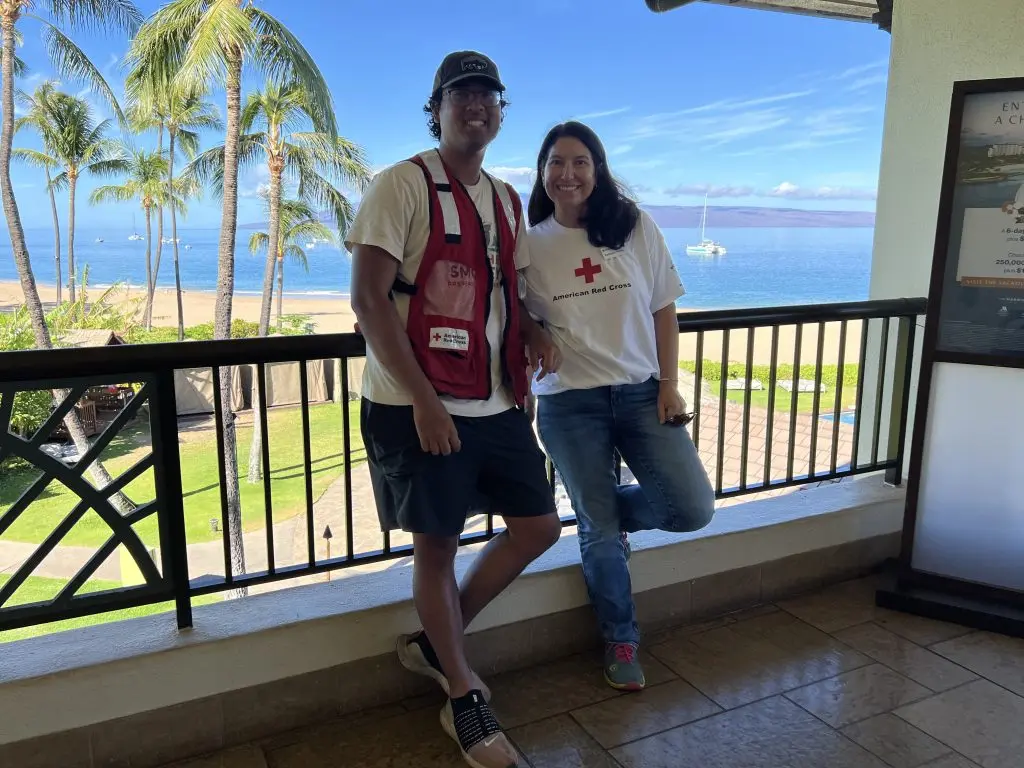
One of the things I especially like about Red Cross deployments is seeing some of the same volunteers everywhere I go. There are a handful of volunteers who deploy regularly, even doing virtual deployments. One of my favorite volunteers is Lori from Michigan. She started the Lahaina deployment as a virtual reunification worker. She was tasked with helping clients locate missing friends and family. Lori loved the reunification work, but she really wanted to physically be in Lahaina for face-to-face client interactions. Because of this, she deployed to Lahaina as an intake worker, and we often worked together. One day, she overheard a man checking in at the front reception area. She recognized his voice and knew his name immediately. He was a husband she had been working with virtually, trying to help him locate his missing wife. He did not know she had transferred to Lahaina, and she did not know he would be there that day. It was a wonderful chance encounter after sharing such intimate conversations over the phone. The meeting was saddened by the news that his wife was still missing. Heartbreakingly, Lori later learned that the wife had been found deceased.
SMOKE & ASH
One day while I was working at the Civic Center, I went out to my car and noticed smoke smoldering in the lot behind where my car was parked. I was curious, so I walked closer. I pointed it out to others near me to see if they thought it was concerning. Of course, everyone was on edge and immediately thought it should be reported. I didn’t think we needed to make a big deal out of it, and I figured I could handle it on my own. As I approached the area that smoke was coming from, I realized that the whole area I had now walked into was still smoldering and was covered in about two feet of ash. It just looked like an open field of dirt. As my feet sank, my mind instantly jumped to, “You are stuck standing in the ash of humans.” I panicked. I froze. Then, I breathed and reminded myself that I was NOT standing in the ash of humans. I was however standing in a field of ash most likely from the houses and trees that once stood where I was standing. As I looked down, I could see holes with smoke rising. I kicked more dirt over them, not sure exactly what the right thing to do was, but not wanting to have come all this way and done nothing. As I wobbled back to solid ground, security rolled up in their golf cart and clapped for me. I cried and laughed at the same time. It was when I got to the shower that night and took off my shoes that I fully cried. My feet were black with soot from the ash that seeped through my shoes and socks. I realized that the people I was meeting with each day probably had black feet too.
LOVE
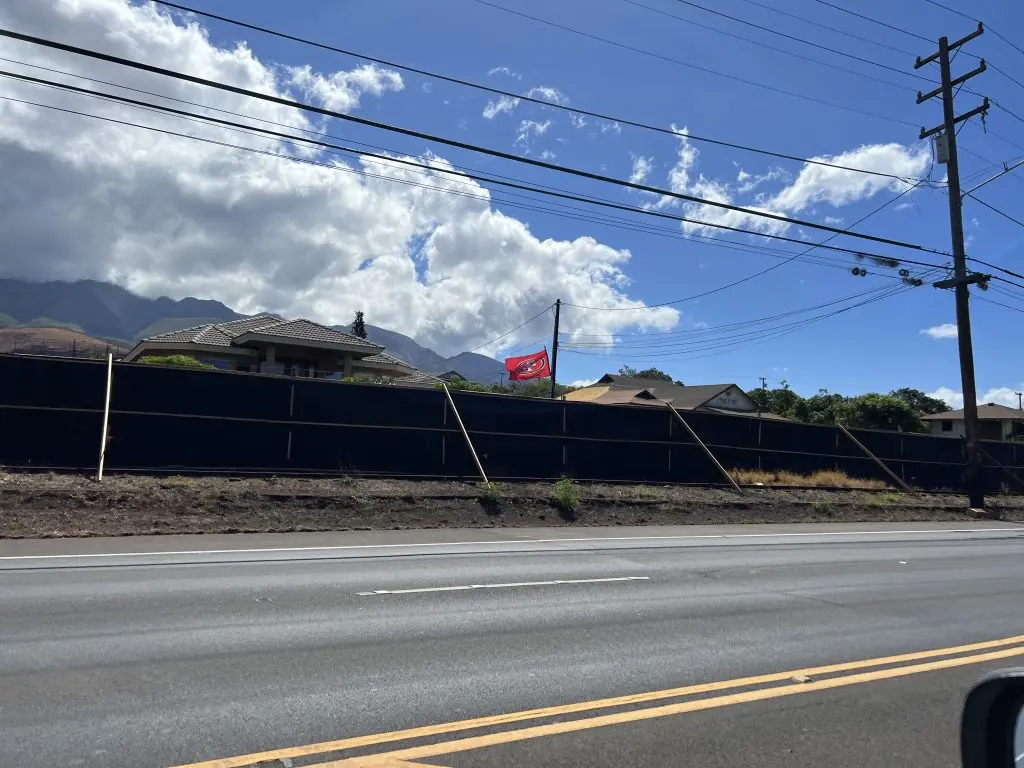
The community of Lahaina had been destroyed. The surrounding neighborhoods and other islands have encircled the area with love, though. Everywhere you looked along the road into town there were signs for free meals, free internet, household donation pick up sites, and more. I drove through Lahaina twice a day going between my shelter and work locations, so I became very familiar with the area. One of my favorite things to look for along the drive was the San Francisco 49ers football flag. A house hung the flag on the fence between the highway and their burned out street. I wasn’t able to drive into their neighborhood, as the National Guard was still blocking off the streets. As a native Northern California girl, I could appreciate their love for the team. In fact, the 49ers won the NFC championship game sending them to the 2024 Super Bowl. I’m sure that the Lahaina family was happy, even if the loss was a little tough!
CARPOOLING
On my first day heading to work, I was in the car with three other people. This was the first time I had met any of them. The driver, I’ll call him Jim, gruffly told me that he used to be a pilot and does not need help with navigation or any backseat driving. Ok, captain! Shortly after that, the lady sitting in the passenger seat, Sally, said to the rest of us quietly chatting in the back, “We should probably keep our voices down so he can concentrate on driving.” It was all I could do to not point out that her Spanish lesson podcast was playing through her phone, not through the headphones she was wearing. On the way back that night, I jumped into the passenger seat, causing Sally to sit in the back. She was “helpful” enough to tell me that my job upfront was to watch out for people walking in the street and point out red lights to Jim. I then understood Jim’s earlier comment to me about his driving abilities.
CHURCH
I started work on a Sunday. I was told we would get a late start since it was a “family day” on the island, and we wouldn’t have too many early appointments. I took that as an opportunity to walk around and meet people at my new home away from home. The first lady I talked to said she was on her way to mass at the local Catholic Church, Saint Theresa’s, and asked if I wanted to tag along. Sure! It had been a while since I last went to church, and it seemed like a good way to start my deployment. When I got there, I sent my mom a picture of the church because I knew she would be happy that I was going. She wrote back right away saying that she had been to that church many times as it is her favorite church on Maui. That made it feel extra right! Towards the end of mass, when the priest was saying his final statements, he looked right at my new friend and I, both wearing our work clothes (Red Cross vests), and told the congregation that there were extra special guests at mass. He said that volunteers from the Red Cross were in attendance and asked everyone to pray for us. I, of course, started crying, feeling the importance of what I was there to do before I had even started.
JOEY’S KITCHEN / GAZEBO
One of my favorite places to eat on Maui is The Gazebo in Napili. Although it was almost an hour from my shelter, I was super excited to drive there for breakfast on my day off. Pineapple pancakes, a few feet from the ocean, and under a gazebo! My type of place. Unfortunately, when I got there, they were not open. I assume this was due to the fire, as many places were still closed. I searched for a different breakfast place and found nothing tempting until I saw Joey’s Kitchen listed on Google Maps. Some good friends of ours, Josh and Kahli Grantz from Las Vegas, always talked about Joey’s Kitchen, and it was only a mile from my current location. They are longtime friends with the owners of the restaurant, Chef Joey Macadangdang and his wife, Auntie Juvy, so I was eager to introduce myself and finally have a real meal. When I got to the restaurant, I noticed a man sitting on one of the restaurant chairs. The restaurant was not open yet, so I walked over to sit and wait too. It was then that I realized I knew the man. His name was Loe, and he was one of the first homeless men I opened a case for. He had a very quiet and sweet personality, and I instantly cared for him. I had not seen Loe for a couple of weeks and was shocked to see him so far from where we had met. Apparently, he had relocated from “living” in front of the Safeway in Lahaina to “living” in front of the little grocery store in Napili next to Joey’s Kitchen. He looked at me, and I looked at him, both with expressions of, “Do you remember me?” Of course we both did, and we sat and talked for a bit. It was such a special way to start my day off in the morning.
As far as Joey’s Kitchen is concerned, it was a wonderful treat too. I met Auntie and several of her employees that morning. I learned that Chef and Auntie, along with most of their employees, had lost their homes, and I was able to give them some general guidance as to what their next steps should be. Some employees and other restaurant patrons who overheard me talking and joined in the conversation did not even realize that they qualified for financial assistance through the Red Cross. It was a win-win sort of day.
This Washington Post article has a nice story about Joey’s Kitchen and how they have been helping their community recover. The article states that Chef and Auntie provided hundreds plates of food a day to anyone who was hungry: community volunteers, affected families, first responders, or anyone in need. I’m not talking about just scraps. They served fresh salad, mahi mahi, steak, shrimp, pork chops, and even venison chili. As if that wasn’t enough, they also used their restaurant to offer shelter to any of their employees, friends, and family who were displaced in the days after the fire. As of my deployment, Chef and Auntie were still living at the restaurant.
SAFE HARBOR
I left Lahaina the day before Safe Harbor expired, on September 29, 2023. Safe Harbor was a program designed to provide shelter, food, mental and physical care, reunification services, and casework to all who were in need, regardless of their pre-fire shelter status. Safe Harbor eligibility criteria was determined by the state of Hawaii and FEMA. Up until September 29, Red Cross shelters were open to everyone, providing temporary housing at 40 locations around Maui. This practice falls within Red Cross’s mission, “to prevent and alleviate human suffering in the face of emergencies by mobilizing the power of volunteers and the generosity of donors.” Not everyone was happy about it, though. Many Lahaina residents were used to living among the homeless in their community but not living with them. Red Cross shelters were mixed with all clients, previously housed or not.
Most of the large resorts sheltered their employees and their families, with the help of the Red Cross. The remaining rooms were filled with the rest of the Red Cross clients. From large families squeezing in, to single people with dogs, everyone took whatever space they could. It seemed weird to see a previously homeless man with his dog walk down the hallway in the Grand Hyatt where my husband and I spent our honeymoon 20+ years ago!
I do not know how the resorts will recover from the amount of use and abuse they have seen over the past few months. Sure, signs say, “respect others, no smoking, walk your dog outside,” but if you wander down any hallway, in any of the hotels or shelters, it’s just as if you were walking down the street outside. People smoking, eating, playing loud music, fighting, and just hanging out commiserating. They didn’t have anywhere to go; they didn’t have anything to do and were angry. Things got worse when the word spread that Safe Harbor was ending and the homeless would be transitioned out of the shelters. The Red Cross had a very thorough and thoughtful transition process, in my opinion, but anytime someone is being required to do something they don’t want to do, it creates havoc.
The other problem with Safe Harbor ending was the confusion that it caused. News reports started showing up saying that the Red Cross was kicking people out of the hotels to make room for tourists. That was simply not true. Clients who had been told they were allowed to stay in the shelters for the next six months to a year started panicking. My days were filled reassuring clients that the news reports and rumors were wrong and that the shelters were not closing.
With Safe Harbor ending, some of the clients, whom I had grown to care for, were leaving. I didn’t know then, and still don’t, if leaving the shelter was good for them or not. Two different couples I befriended had significant domestic violence problems. In both cases, the woman was the victim and often sought comfort talking to me or one of the spiritual care volunteers on my team.
There was a sense of overall safety in the shelter having so many people around, but at the same time, by being in the shelter, people’s tempers were hot and short. There wasn’t any breathing room to decompress.
First couple: Kahli’s boyfriend had been sober for 10 months and relapsed after the fire. He was depressed and was spending all day drinking with other clients and often didn’t return to the room until dark. Kahli was scared of him when he drank. Prior to his former sobriety he was violent with her when intoxicated and she was scared he would be again if set off. The couple was often heard yelling and throwing things in the room, and security eventually kicked them out of the hotel.
Second couple: Mia came to me one day asking if she could get a separate room from her husband. When pressed, she admitted that he was “rough with her” at night when he got back to the room after drinking and smoking weed all day. At home, she said she would usually just make him sleep downstairs on the couch, but the hotel room was so small there wasn’t anywhere else for him to sleep it off. We discussed the option of having him leave the shelter, but she said she would leave the shelter if we asked him to leave. Giving the couple two rooms, when some families were still on the waitlist for a room, wasn’t a possibility. I don’t know what the solution is to situations like these, but I felt very inadequate not being able to do anything to help these women.
Sadness
While on deployment, volunteers get one shift off per week. For me, this day usually consists of sleeping in, eating at a restaurant, doing laundry, catching up on emails, and of course, calling home. Between the long shifts and the time zone change in Hawaii, staying in touch with home was challenging. On the rare moments when I did have free time, I usually didn’t feel like calling and pretending to be happy so people wouldn’t worry about me or calling home crying and not being able to return to my work table until my face looked normal again. I am not a pretty crier. Now that I think about it, this post is the first time I have shared many of these details with anyone. Ironically, today I received an email from the National Red Cross informing me that I will be receiving a deployment pin for my time spent in Lahaina. I am not surprised that I will receive a pin, but the timing of the email is ironic. I have been putting off writing this blog for months, and when I finally do sit down to start it, I get an appreciative email and a token of thanks for my efforts. I take that as a good sign that I’m meant to finally be writing this!
However, I have to admit that I have been putting off writing about the hard stuff. I don’t want to remember the devastating stories, the faces, the smells, or the destruction. It’s easy to write when you’re happy. The feelings of happiness take over, and you want everyone around you to share in that feeling. You want to show pictures, tell stories and make plans for future good things. The saying that happiness is contagious is true, but sadness is also contagious. By writing about sadness, you inherently share that weight with the reader and potentially impact them as well. The story of my time volunteering with the Red Cross after the fire in Lahaina is one of those cases. I want to share my experience. I want to tell first hand stories about the survivors. I want to sing the praises of those who made a difference. I want to lighten the load I carry. Is that selfish? Maybe. It is with sincerity that I say if you are not in a good mental space right now, skip this part of the post. I will not be offended. I will not know. It is with a very sad and heavy heart that I finally write some of the stories clients shared with me. Just because it is the right time for me does not mean it is the right time for you. That’s ok!
Keoni
That brings me to my first memory. I met Keoni during my first week. He came to me asking for help because he was told he needed to move out of the shelter the following day. At this point in the recovery process, no one was being transitioned out of shelters yet, so I was confused. He informed me that his wife left the shelter the day prior to relocate onto a different island with family. Due to medical needs, Keoni was unable to leave Maui. Since he shared a Red Cross case with his wife, as is standard, when she left the shelter, it automatically started the transition process for him to leave too. This is clearly a flaw and could be cleared up with a little effort. The frustrating part is what I couldn’t help with. I sat with Keoni for about an hour letting him just talk. He told me how depressed he was. He missed his wife and the family dog which she took with her. His closest family member, a cousin, just committed suicide because he lost his mother (Keoni’s aunt) in the fire. Keoni felt lonely and was alone. He would wander the lobby floor every day just swaying back and forth and looking off into the distance for long periods of time. I had our mental and spiritual workers stop by and talk with him when they could, but he kept becoming more withdrawn. I reported that I was worried about him becoming suicidal based on our conversations. The next day my team was transferred to a different shelter, for reasons unrelated to this case, and I never saw him again. I have no idea where or how he is now. I hope and pray he found a way to keep moving forward. One of the silent tragedies of the Lahaina fires is the number of people who have committed suicide or are contemplating it. I heard stories of suicide every day. I never once heard it discussed on social media. Please, be kind to each other, and ask for help if you need it. If you need help call 988 or check out the website: https://988lifeline.org/
Amelia
Amelia was another one of my regulars. She would often come by just to say hi, or Aloha actually. She had been living in Lahaina for most of her life. I’d guess she was about 30 years old. She and her boyfriend worked with the local kids teaching them to surf and skateboard. I’m not sure what their actual professions were, but she always talked about teaching the kids and finding donations for kids who couldn’t afford the boards. One day she looked especially quiet, and I asked her if she wanted to talk somewhere privately. She told me that she can’t stop hearing the pitter-patter of little feet running alongside her down the burning street. She said she tried carrying as many kids as she could, but there were too many of them to hold. She just kept crying and repeating over and over, “Their little feet, the pitter-patter of them. Those little feet burning.”
Bane
Bane was a man in his fifties. He was one of the many men who would sit across from me, shake my hand, and tell me his family was doing fine. I would look at him, give a little smile, and ask him how HE was doing. More times than not, he would pause, take a deep breath, and have tears start forming in his eyes. In these moments with clients, you just have to sit there, maybe put your hand on their hand, and reassure them that this too will pass and that they are doing all the right things by coming to get help. They are so busy trying to keep the family afloat that they often don’t take time to grieve themselves. You can tell that they are carrying the weight of the world on their shoulders and my job was to reassure them that they can survive this.
Michael
Michael was wheeled up to my table, as he had just been released from the hospital. He had major burns on his feet and had several skin grafts. Many people who were in our shelters had burns of various degrees. This man’s situation was one of the worst I had seen. He shared with me that he was trapped when the fire came down the street. His only clear path was to jump over the seawall and into the ocean. Michael was in the water for nine hours. By the time he was able to get back over the seawall, his extremities were so swollen that he could barely walk and could not feel his feet. When he made his way to the firetruck, his feet were damaged almost beyond repair. He had lost his shoes in the ocean and could not feel the pain of walking over hot embers. He had no idea the damage that had occurred until he was finally rescued.
When Michael was in the water, he said bodies were just floating around him, some dead, some alive, and some still on fire. There was nothing he could do. He couldn’t help them. He couldn’t help himself. All he could do was wait for help to arrive. He said that he will never forget the image of watching people on the street burn alive while he floated out in the water. He wasn’t sure which of them made the right choice. To jump or not to jump.
Roselani
Roselani had jumped into the water with her children to escape the fire. Her children were frightened, screaming, and struggling to hold onto her. All at once she said the children stopped moving, and she knew something more was wrong. There were tiger sharks in the water. Roselani said there were so many of them just swimming among the people. She did not see any of the sharks attack. Later, other survivors told her that they had seen sharks feeding on people in the water. Roselani believes the sharks were just no longer hungry by the time she saw them.
Noah
Noah was very upset with how first responders handled the events that preceded the destruction of Lahaina, gusting winds, power outages, inability to pump water, lack of warning sirens, dry conditions, and panic. I hold no opinion on the matter. I was not there. I am not a resident of Lahaina. My heart breaks for everyone impacted. I am only sharing his story.
Noah saw the fire coming down the hill from the west side of the volcano. Several small fires had occurred within the recent weeks, and many locals assumed this one would amount to nothing serious. Noah said he and his wife had some errands to run on the other side of the island, so they decided to pack up a few things, just in case, and head out of town. By the time they got in their car and started driving, the fire had already reached their neighborhood, and they had to drive in the opposite direction they had intended. It was at this point that they encountered the first blocked road. A power line had fallen due to the strong winds and the street had been closed so cars would not drive over the line. Unfortunately, that was just the first street of many that would become barricaded due to downed power lines.
As more people tried to flee in their cars, the roads simply became un-drivable with so many streets blocked. People started abandoning their cars in an effort to run to safety. Noah saw his neighbors running in the direction they had just driven from and knew they were running right into the fire. He remembers yelling at them to turn around, but it was so loud they couldn’t hear him. He knew he would never see them again.
Malia
Homes in Lahaina often housed several generations of families. Malia lost all of her family in the fire. Her parents were too fragile to run from the fire and, according to neighbors, refused to leave the house. Malia’s children were home with their grandparents and were too scared to leave without them. Both generations perished in the fire. Malia was at work when the fire took her home and family.
Sarah
I really connected with one of my younger clients, Sarah. She was in California with a good friend when she got the dreaded call from her husband who was still in Lahaina. He called to let her know that there was a fire in the area, and while he didn’t think it would get too close to their house, he thought he should evacuate with the kids just in case. Just as that phone call ended, the screaming started. Not screaming in Lahaina, but screaming in the SoFi Stadium in Inglewood, CA because the Taylor Swift concert was starting! Sarah had flown stateside for the concert and didn’t know if she should go back to her seat or stay out where she could hear her phone if he called back or leave and head to the airport. She and her friend spent the whole concert staring at her phone, willing it to ring, and trying to get reception to see if there was news of the fire in Lahaina. Sarah did not hear from her husband again for two days. She had to just sit and wait for cell service in Lahaina to resume. There was nothing she could do from the mainland and there were no flights heading to Lahaina.
I went to bed that night telling myself that I was going to get up in the morning and find a way to reach Taylor Swift and let her know about Sarah’s story. Well, it’s been a couple of months, and I am just now getting around to it. Better late than never, right?! So, Taylor Swift, if you have two extra tickets for Sarah and her friend to actually get to see The Eras Tour, instead of having your music be the background to her worst dream, I’m sure they’d love to go.
Patrick
Some days dragged on. While each individual case had unique circumstances, the basics were usually the same. That was until my last work day when Patrick walked in the door. He was the unicorn client, and I got the pleasure of working with him. Patrick walked into the Lahaina Civic Center one afternoon and basically said, “I heard that I have been missing for six weeks.” He held up his missing person flier with his picture on it. The Red Cross tables were at the entrance to the Civic Center, so we were the first people to encounter him. As you can imagine, things started moving quickly at that point. A nurse rushed over, the FBI & Coast Guard representatives pulled him aside, people started murmuring and trying to take pictures of him. Everyone wanted to know where he had been! They would have to wait because he couldn’t remember many details. He was very weak, hungry, and tired. During the next couple of hours, several things happened, many of which I do not know. Eventually, he was brought back to our Red Cross tables to open a case and be assigned a shelter. At this point, my protective momma self took over, and he was not going to get out of my sight again. When we walked outside to wait for the shelter driver, Patrick spotted a rainbow. He smiled and said he hadn’t felt happiness until that minute. He asked if he could take his picture with our little group to show his family the Red Cross volunteers who saved him. Needless to say, we all agreed.
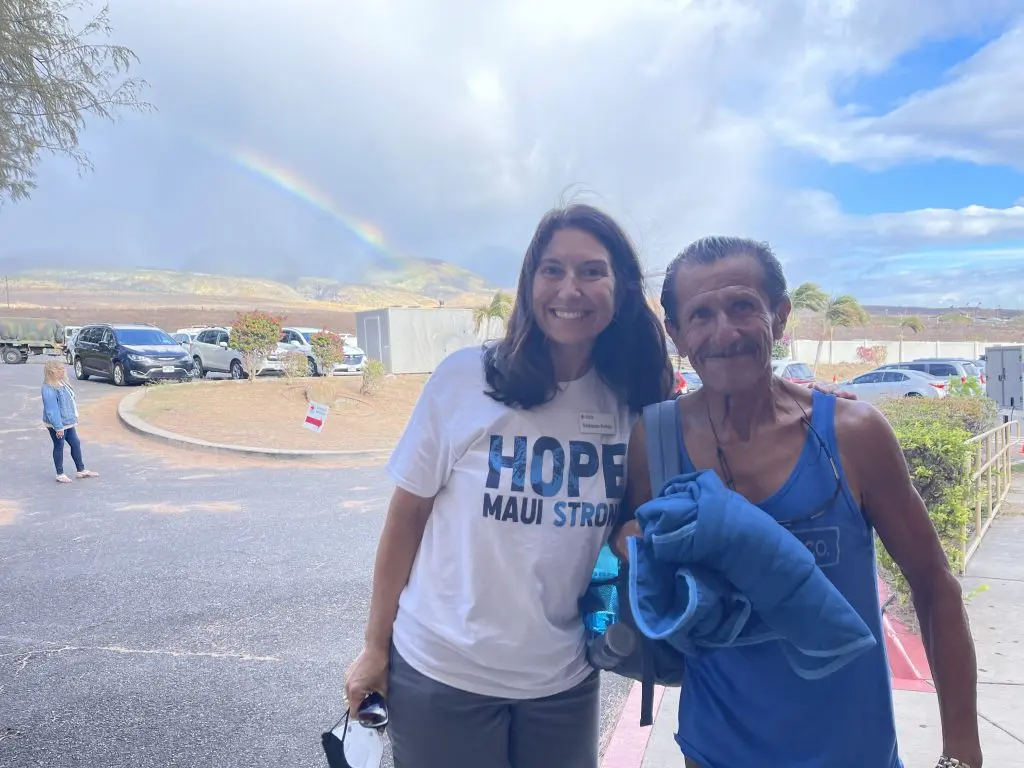
I followed the shelter driver in my car, making sure the driver knew to wait for me at the entrance of the Hyatt and not let anyone know who he was transporting or why he was getting dropped off. The last thing we needed was for Patrick to be bombarded with people asking him for details he couldn’t remember. The lobby was always packed with Red Cross volunteers, hotel staff, and dozens of other clients hanging around with nowhere to go. I just wanted to get Patrick inside and to his room.
Once the shelter supervisor and I got him settled, the first thing he asked me was to take a picture of him holding his missing poster. He wanted to send it to his daughter along with the one we took at the Civic Center.
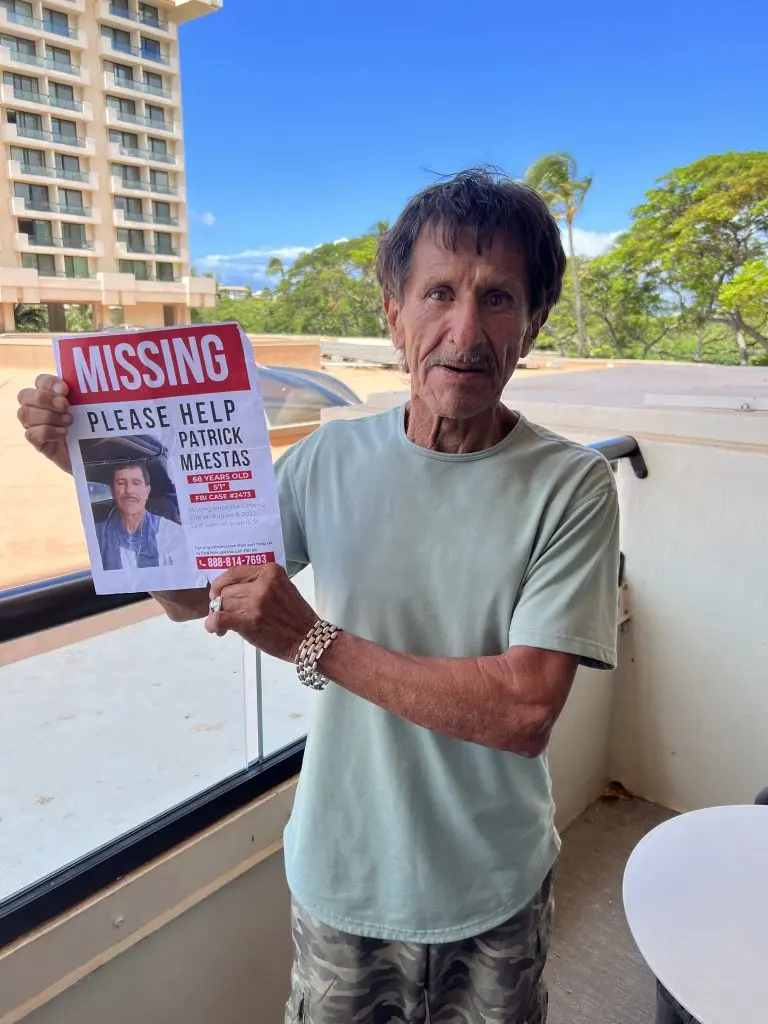
I could go on and on here about his reaction to the Hyatt, his huge room, his fluffy bed, the shower, the view, and the TV, but you probably don’t need me to describe how overwhelmed and pleased he was.
The hotel supervisor asked Patrick if he had been given food yet. He said he had at the Civic Center. She asked if he was still hungry, and he said, “Yes, I am, because I couldn’t eat the food they gave me. I lost my dentures in the ocean, and I can’t chew.” Amazing! He was thankful for the food he had been given and didn’t want to complain by saying he couldn’t eat it. Obviously, the first thing we did was get him some soft food. He confided in me that what he really wanted was chocolate. His favorite was Butterfingers, but he’d really love any sort of chocolate. We left Patrick in his room for the night, promising to return the next day to check on him and bring him chocolate.
As promised, I returned with a big bag of Butterfingers. I asked what he had done the previous night, and he said he called his family to let them know he had survived. It turns out that he has a daughter in Utah and a sister in Las Vegas. My heart burst open. I have a son in Utah, and my husband and I live in Las Vegas. Once again, the small connections I found with the people of Lahaina just continued to tell me I was in the right place, doing the right things.
Patrick had one last request for me. He really wanted clean socks and a sewing kit from the store. He had been given clothes to wear, but he had lost so much weight, everything was too big. Patrick said he was used to sewing his clothes and could easily make alterations. Very cool!
You’re probably wondering where Patrick was during the six weeks he was missing. Good question. Unfortunately, I don’t have a great answer. I met him on my last work day and flew home just two days later. We are not allowed to keep in touch with clients after we return home, so I have not heard from him since. The last memory he told me was that he had jumped into the ocean to get out of the way of the fire. He stayed on the seawall for an unknown amount of time. At one point, he remembered seeing a Coast Guard ship, but it was going in the opposite direction. He managed to get to shore and recalls being unable to walk due to his feet being too swollen.
At some point, he remembers feeling afraid and hiding from people when he saw them. He remembers walking up to a homeless encampment to get food and water and someone showing him his face on the poster. He had no idea six weeks had passed. He felt like the fire had just happened the day or two before. He was as surprised to hear he had been missing as people were to see him. At the homeless encampment, he was treated for a large gash on his head and realized that one of his eyes was unable to see well. He does not know how or when that damage occurred. After being given some clothes and a shower, he was sent to the Civic Center and found me. You know the rest of that story.
Part of me hopes Patrick’s memory has come back to him so he can put together pieces of his puzzle, but at the same time, not knowing what those memories hold, maybe his not remembering is ok too. I know he feels blessed to be alive, and that’s what really matters.
(Patrick gave me written permission to use his name and show his picture.)
Community
I have been on many Red Cross disaster relief operations, but to me, none felt as tragic as this one. Each person suffered in their own agonizing way, but they are all coming together to recover as one, united community.
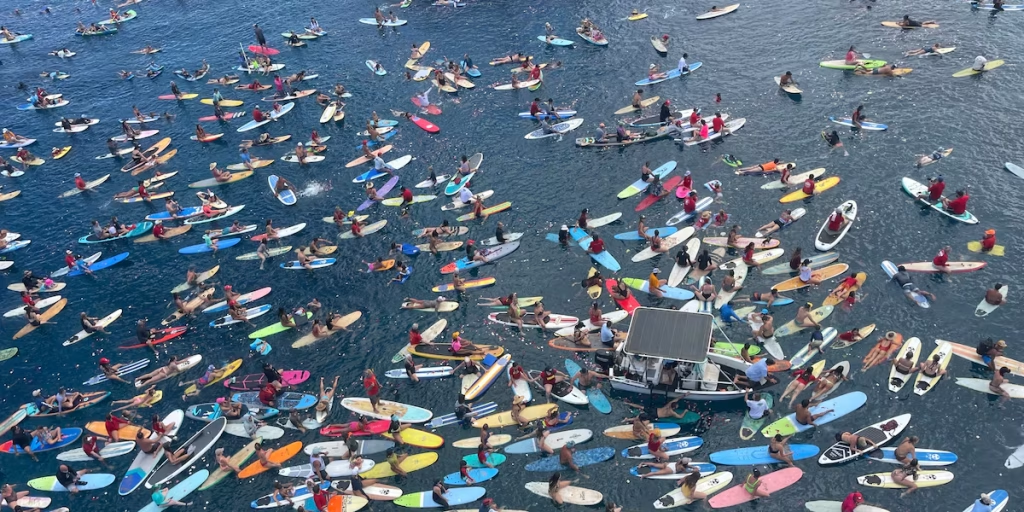
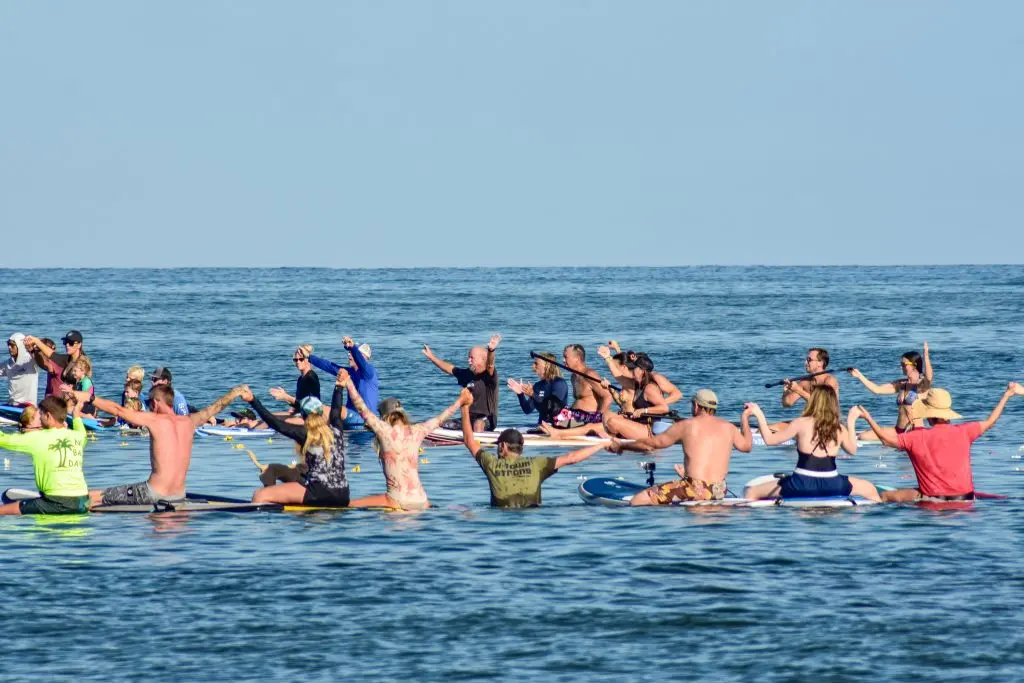
Exactly one month after the August 8, 2023 fire, hundreds of community members gathered in a surf spot known as Thousands Peaks. They paddled out on their boards to grieve, heal, remember, and honor the victims of the fire. Participants scattered flowers and sang songs. Paddle out events like this one took place all over the island and often included a boat line up and a flower drop from a hovering helicopter.